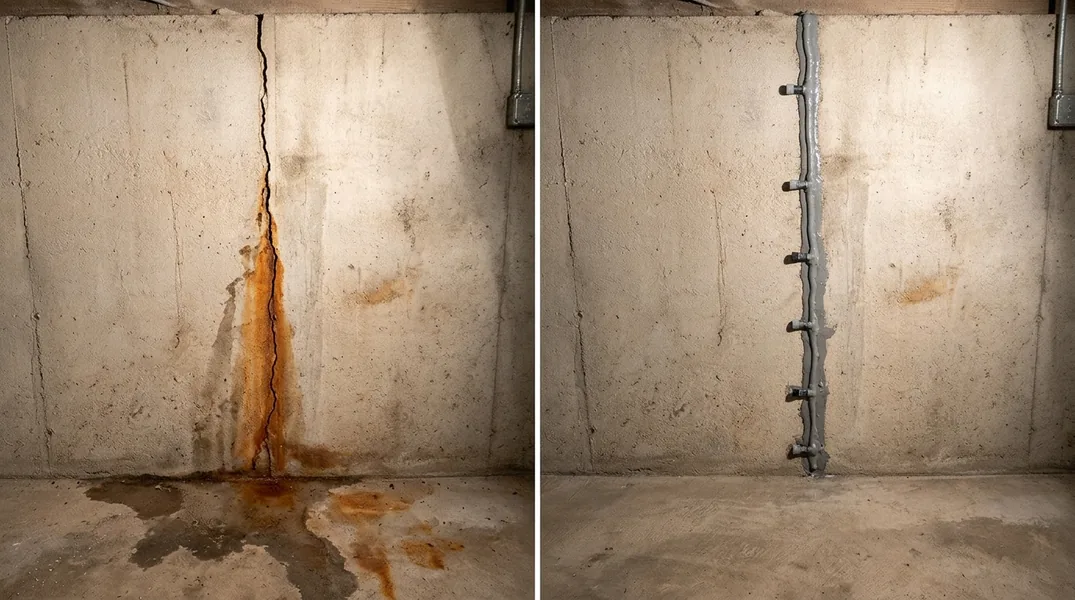
Why Post-War Homes in Arlington Heights Are Prone to Basement Water Problems
If you live in a split-level or ranch built between the 1950s and 1970s, you own a piece of Arlington Heights history. These post-war home basement designs were built fast to house a growing population, and the waterproofing methods of that era were far less robust than what we use today. Many of these homes were constructed with block basement wall cracks that were sealed with nothing more than a coat of tar or a thin parging layer, materials that have long since dried out, cracked, and failed.
The result is a familiar story for local homeowners: a damp smell in the lower level, efflorescence (that white chalky powder) on the walls, or water pooling along the floor after a heavy spring rain. Because these homes sit on some of the same clay-heavy soil found throughout the northwest suburbs, water has a hard time draining away from the foundation. Instead, it pushes against the walls and finds every weak point. Understanding why your older home leaks is the first step toward fixing it for good.
Block Basement Wall Cracks and the Split-Level Leak Problem
Concrete block foundations are common in mid-century construction, and they have a built-in vulnerability: mortar joints. Each joint between blocks is a potential entry point for water, and over decades, the mortar can soften and crack. A split level basement leak often shows up right at these joints or where the block wall meets the concrete floor. Split-levels add another wrinkle because the lower level is partially below grade, so the foundation wall on the buried side takes on more hydrostatic pressure than the rest of the house.
Homeowners sometimes try to patch these cracks from the inside with hydraulic cement or a coat of sealer, only to watch the leak return the next season. That is because the water is still entering the block cores from the outside. A proper repair addresses the source, not just the symptom. Depending on the situation, this may involve Foundation Waterproofing to seal the exterior, or an Interior Drain Tile System to manage water that reaches the footing. A trained eye can tell you which approach fits your home.
Ranch Home Basement Drainage: Where the Water Goes (and Where It Shouldn't)
Ranch homes from this era were often built with a perimeter drain tile system made of clay or cast-iron pipe. These pipes have a lifespan, and after 50 or 60 years, they are frequently crushed, clogged with roots, or simply collapsed. When the original basement drainage fails, groundwater has nowhere to go but into the basement. You may notice water seeping up through the floor cracks or along the cove joint where the wall meets the slab, especially during the wet weeks of March and April.
Modern basement drainage solutions replace that failed system with a reliable interior drain tile that captures water at the footing and routes it to a sump pump. For a ranch home basement, this is often the most practical fix because it does not require excavating the entire exterior. In some cases, though, Exterior Basement Waterproofing is the better choice, particularly when the goal is to stop water before it ever touches the foundation. A thorough evaluation will determine which path makes sense for your property and your budget.
Basement Waterproofing Near Me: When to Call a Professional in Arlington Heights
Not every damp basement requires a major project, but some warning signs should prompt a call to a professional. If you see standing water after storms, notice cracks that are widening, or smell a musty odor that never goes away, it is time to have the foundation inspected. Small issues in a post war home basement can turn into structural problems if water is allowed to freeze and thaw in the block walls through the winter. Catching them early usually means a simpler, less expensive repair.
When you search for basement waterproofing near me, look for a local company that understands the specific construction of mid-century homes in the area. Arlington Heights Waterproofing has worked on countless split-levels and ranches in Palatine, Mount Prospect, Buffalo Grove, and right here in Arlington Heights. We know where these homes tend to fail and how to fix them without overbuilding. Call (224) 427-5558 to schedule a free estimate and get a straight answer about what your basement needs.
Basement Waterproofing Cost in Arlington Heights: What to Budget
Every basement is different, so there is no single number that fits all homes. The pricing for a project depends on the length of the foundation, the severity of the leaks, whether a sump pump is already in place, and whether you choose an interior or exterior approach. A straightforward interior drain tile installation on a ranch is typically less involved than a full exterior excavation, but the right solution is the one that actually solves your water problem, not simply the cheapest option on paper.
The best way to get an accurate figure is to have your home inspected by a professional who can point out exactly where the water is entering. We provide clear, written estimates so you can compare options and plan accordingly. For homeowners dealing with a split level basement leak or a failing drainage system, investing in a proper repair now is far less costly than repairing water damage, mold, or foundation issues later. Reach out to Arlington Heights Waterproofing at (224) 427-5558 to discuss your basement and get started.
Looking for a professional basement waterproofing contractor in Arlington Heights? Arlington Heights Waterproofing responds fast for all your basement waterproofing needs.
Get a Free QuoteOur services: Basement Waterproofing · Interior Drain Tile System · Exterior Basement Waterproofing