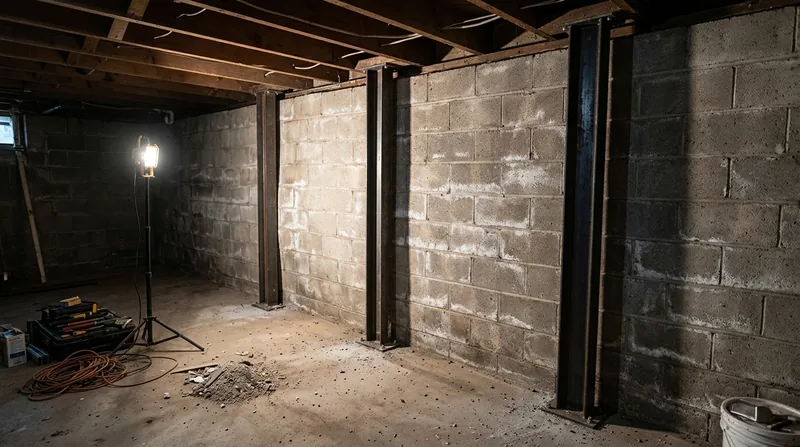




Arlington Heights sits on flat glacial clay plains northwest of Chicago, and that dense till drains slowly. When spring rain or snowmelt saturates the ground, the water table rises and pushes hard against basement walls. In the 1920s-1940s bungalows and Tudors of Scarsdale and Arlington Park, and in the 1950s-1970s brick ranches on block foundations across town, that pressure shows up as a wall that leans inward. If you are searching for Bowing Wall Repair in Arlington Heights, the fix is not cosmetic. A bowing wall is a structural warning, and the method we use depends on how far it has moved and what your soil is doing. We stabilize the wall with carbon fiber straps, steel I-beams, or wall anchors, matched to the severity of the movement. Call (224) 427-5558 for a free basement inspection, and read our basement waterproofing service page to see how the wall repair fits with water control.
Why Bowing Walls Show Up in Arlington Heights Block Basements
Most bowing walls we see in Arlington Heights are on older block foundations, not poured concrete. Block walls are strong in compression but weak against sideways load. Saturated glacial clay soil pushes inward, and the winter freeze-thaw cycle works the joints loose. The wall bows toward the basement, and the top courses can drop or crack.
- Hydrostatic pressure builds when clay soil holds water after heavy spring rain or snowmelt.
- Frost heave in January and February pushes against the outside face of the wall.
- Original footing drains and weeping tile clog with clay fines and stop relieving the pressure.
- Downspouts that discharge too close to the foundation add water right at the wall line.
If you see a horizontal crack in the middle of a block wall, or the wall is out of plumb by more than an inch, get it looked at before the next freeze. Efflorescence and wall seepage often show up first.
Key info: A 1950s ranch near Pioneer Park had a block wall bowed about 1.5 inches after the April 2013 floods on the Des Plaines River. The footing drain was full of clay, and the wall had been moving for years. We relieved the water first, then anchored the wall.
Permits for structural foundation repair are commonly required, and the Village of Arlington Heights Building Department sets the rules. Verify requirements with them before work starts. You can check the village's official site at vah.com.
How We Repair a Bowing Wall in Arlington Heights
We start by finding out why the wall moved, not just where it cracked. An inspection checks the wall for plumb, maps the cracks, and looks at grading, downspouts, and the footing drain. Then we match the repair to the movement.
- We measure how far the wall is out of plumb and check for horizontal cracking and block displacement.
- We relieve hydrostatic pressure with an interior perimeter drain and sump basin where water is the driver.
- We install carbon fiber straps on walls with moderate movement, or steel I-beams where the load is heavier.
- We set wall anchors through the yard into stable soil when the wall needs to be pulled back and held.
- We seal cracks and parge the wall face, then verify the sump pump and check valve work.
The right method depends on severity and soil, and we tell you plainly when crack sealing alone is not enough.
Key info: On a 1960s split-level in Mount Prospect, the wall had moved less than an inch. Carbon fiber straps held it without excavation. A Buffalo Grove colonial with a poured wall needed anchors because the clay behind it stayed saturated. Same symptom, different fix. See our foundation crack repair page for the crack side of the work.
Repair Methods We Match to Your Wall and Soil
| Approach | Description | Best for |
|---|---|---|
| Carbon fiber straps | Straps bonded vertically to the inside face and anchored at the footing and sill. | Moderate bowing under an inch, block walls, minimal excavation. |
| Steel I-beams | Vertical steel beams set against the wall and tied into the floor and joists. | Heavier movement, tall walls, walls that must be held, not pulled. |
| Wall anchors | Plates on the inside wall connected to anchors driven into stable soil outside. | Walls that can be straightened over time, saturated clay sites. |
| Drainage correction | Interior perimeter drain, sump basin, and discharge line to cut hydrostatic pressure. | Walls moving because water is the driver, not just soil load. |
We combine methods when the wall and the water both need attention. A strap alone will not fix a wall that is still being pushed by saturated clay.
Bowing Wall Repair Cost in Arlington Heights: What to Expect
Pricing for bowing wall repair starts at From $600 for minor crack and wall sealing work, and rises with the method. Carbon fiber strapping, steel beams, and wall anchors each carry different material and labor costs. The number that matters is the one after an inspection, not a phone quote.
What moves the price: how far the wall has bowed, the wall length and height, whether the footing drain needs replacement, and access to the basement. A Scarsdale bungalow with a short block wall is a different job from a two-story Colonial in Schaumburg with a long poured wall. Getting two or three estimates is smart, and any contractor who quotes without measuring plumb is guessing.
Our full pricing overview lays out the ranges by method so you can compare.
Choosing a Bowing Wall Repair Contractor Near Arlington Heights
Ask for proof of licensing and insurance before anyone touches your foundation. Structural work carries real risk, and a certificate of insurance should be available on request. Get at least two estimates in writing, and ask each contractor how they measure plumb and what method they recommend and why.
Check references from jobs in Arlington Heights, Palatine, or Mount Prospect, ideally on the same era of home. Confirm who pulls the permit with the local building department, and ask how they handle drainage corrections. A contractor who only straps walls without addressing water is solving half the problem.
Reach us through our contact page to schedule a free inspection. We are a Basement Health Association member and we work below grade only.
Key info: We serve Arlington Heights and the surrounding suburbs, including Palatine, Mount Prospect, Buffalo Grove, Schaumburg, and Des Plaines. If your wall is moving, call (224) 427-5558 and we will get an inspector out.
Bowing Wall Repair in Arlington Heights: Pricing Guide
| Service | Price | Details |
|---|---|---|
| Crack and wall sealing | Starting at $600 | Minor crack sealing and wall sealing, priced by linear feet and number of cracks treated |
| Carbon fiber strapping | Starting at $1,800 | Straps installed on a moderately bowed wall, priced by wall length and strap count |
| Steel I-beam or wall anchor system | On estimate | Heavier movement needs an on-site look at wall height, soil load, and access |
| Drainage correction with wall repair | On estimate | Interior perimeter drain and sump work added when hydrostatic pressure drives the movement |
| Travel | Included | In Arlington Heights and surrounding areas, no separate call-out or mileage fee |
| Estimate | Free | Response within 24h at (224) 427-5558, no obligation to book |
Indicative pricing, the exact cost depends on square footage, finish, and site access. Free personalized estimate within 24h at (224) 427-5558.


