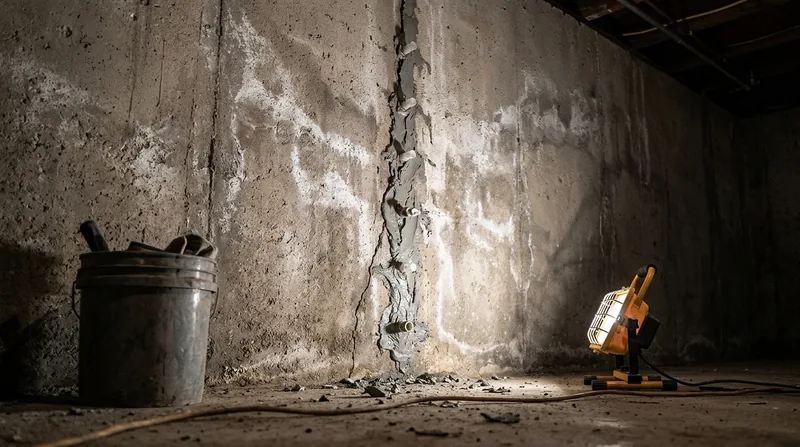




If you have a crack in your foundation wall letting water into the basement, you are not alone in Arlington Heights. This village sits on flat glacial clay till northwest of Chicago, and that dense soil drains slowly. When Weller Creek or McDonald Creek backs up during a spring storm, the water table rises fast under the older brick and block foundations near downtown and in the Scarsdale and Arlington Park neighborhoods. Foundation crack repair in Arlington Heights starts with one question: is this a shrinkage crack that needs injection, or a moving wall that needs structural work? We answer that on site before anyone picks up a drill. Call (224) 427-5558 for a free basement inspection and a straight answer.
Why Foundation Cracks Show Up So Often in Arlington Heights Basements
The housing stock here explains most of what we find. Four-square and Prairie-style homes from the 1890s to the 1920s sit on brick and block foundations that have taken a century of freeze-thaw cycles. The 1920s to 1940s bungalows and Tudors on full basements in Scarsdale and Arlington Park show the same pattern: a hairline vertical crack that has been seeping for years, with white efflorescence blooming on the wall. The 1950s to 1970s brick ranches and the split-levels across town add block basement walls with mortar joints that open as the clay swells and shrinks each season.
- Vertical cracks near the middle of a wall usually come from concrete curing shrinkage and are prime candidates for epoxy injection.
- Stair-step cracks along block mortar joints often point to differential settlement or frost heave pushing the footing.
- Horizontal cracks, especially with a wall that is bowing inward, mean hydrostatic pressure from saturated glacial clay is winning and need structural repair.
- Water staining after a heavy rain, with no visible crack, can mean the crack is on the exterior face and the water is traveling through the wall.
Sorting the crack type first is what keeps a $450 injection job from being sold as a $15,000 excavation, and it is what keeps a moving wall from being patched and forgotten.
Key info: A 1940s Tudor off Arlington Heights Road had a vertical crack seeping every March. The homeowner had been patching it with hydraulic cement for six years. A 20-minute inspection showed a clean shrinkage crack with no wall movement, and a two-hour polyurethane injection stopped the seep. The patching was hiding the crack, not fixing it.
For the official word on what work needs a permit in this village, check the Village of Arlington Heights building department before scheduling structural work.
How We Diagnose and Repair a Foundation Crack in Arlington Heights
Every crack gets inspected before it gets a price. We map the crack direction, measure width, check for wall plumb with a level, and look at the grading and downspouts on that side of the house. Then we match the repair to what the wall is actually doing. No one-size-fits-all patching.
- We walk the basement and mark every crack, damp spot, and efflorescence line, then check the exterior grade and downspout extensions on the wet side.
- We determine whether the crack is active or dormant by checking for fresh staining and moisture readings along the wall.
- For non-structural cracks, we drill injection ports along the crack at intervals, flush the crack clean, and inject epoxy or polyurethane under pressure until it reaches the exterior face.
- For cracks with wall movement, frost heave damage, or bowing, we recommend structural options such as carbon fiber straps or wall anchors instead of injection alone.
- We finish by sealing and parging the interior surface where needed and confirming the repair with a water test on the exterior side.
The material choice matters. Epoxy injection restores structural strength in a stable crack. Polyurethane injection stays flexible and is the better call when a crack may still move with the seasons.
Key info: A split-level in Mount Prospect had a stair-step crack in the block wall after the 2013 Des Plaines River flooding. The wall had shifted about a quarter inch. Injection alone would have failed within two seasons. We used carbon fiber straps to stabilize it and injected the crack, and it has held through every spring thaw since.
If the inspection shows water coming through the wall in multiple spots rather than one crack, the fix is usually a drainage issue, and our interior drain tile system page explains that path.
Crack Repair Methods We Use and When Each One Fits
Not every crack gets the same treatment. The table below shows how we match the method to the crack and the wall condition. A crack that is stable and dry on the outside gets a different repair than one that is actively seeping under pressure.
| Approach | Description | Best for |
|---|---|---|
| Epoxy injection | Ports drilled along the crack, epoxy injected under pressure to bond the concrete back together. | Stable vertical shrinkage cracks in poured concrete walls. |
| Polyurethane injection | Flexible resin injected into the crack, expands and seals against active water. | Cracks that are seeping or may still move with seasonal clay movement. |
| Carbon fiber straps | Straps epoxied across the wall to resist inward bowing and hold the wall plumb. | Bowing block walls with horizontal cracking under hydrostatic pressure. |
| Wall anchors | Anchors driven into exterior soil and tied to the wall to pull it back over time. | Walls that have moved inward and need to be straightened, not just held. |
| Surface sealing and parging | Crack cleaned, filled, and the wall face parged to close minor seepage paths. | Hairline cracks with no active water and no structural movement. |
If the wall is bowing rather than just cracked, the crack is a symptom, and our bowing wall repair page covers the structural side.
Foundation Crack Repair Cost in Arlington Heights: What to Expect
Most single-crack injection jobs in Arlington Heights start at $450. That covers a standard vertical crack up to about eight feet, port drilling, injection material, and cleanup. The price moves from there based on a few concrete factors, not on how the salesperson feels that day.
- Crack length and width drive the material volume and the number of injection ports required.
- Wall material matters: poured concrete is straightforward, while older brick and block foundations take more prep and sometimes repointing.
- Access to the crack, especially behind finished walls, shelving, or mechanicals, adds labor time.
- Active water at the time of repair may call for polyurethane instead of epoxy, which changes the material cost.
- Structural findings, like a bowing wall, move the job into carbon fiber or anchor territory and a different price bracket entirely.
Get two or three written estimates on the same scope, and make sure each one states the crack type and the method, not just a number. Our pricing page lays out the full range.
Choosing a Foundation Crack Repair Contractor Near Me in Arlington Heights
This is a small-market trade, and the difference between a good repair and a callback is usually in the details of the estimate, not the advertising. Ask direct questions before you sign anything.
- Confirm the contractor is licensed and insured for foundation work in Illinois, and ask for the certificate of insurance, not just a verbal yes.
- Get at least two or three estimates and compare the stated method and crack diagnosis, not only the bottom line.
- Ask for local references from Arlington Heights or a neighboring suburb and call one or two of them.
- Ask who pulls the permit if the work is structural, since foundation repair and drainage alterations commonly require one, and rules vary by jurisdiction.
- Get the warranty terms in writing and confirm whether it is transferable if you sell the home.
We are a Basement Health Association member and we do only below-grade work, so the inspection is done by the same people who will do the repair. Reach out through our contact page to schedule a free inspection at (224) 427-5558.
Foundation Crack Repair in Arlington Heights: Pricing Guide
| Service | Price | Details |
|---|---|---|
| Single vertical crack injection | Starting at $450 | Covers one standard crack up to about eight feet, port drilling, epoxy or polyurethane, and cleanup. |
| Multiple crack injection | Starting at $750 | Priced per crack after inspection, with volume affecting material and port count. |
| Block wall stair-step crack repair | On estimate | Requires on-site assessment of mortar joints, wall movement, and repointing before a number is given. |
| Structural stabilization (carbon fiber or anchors) | On estimate | Needs wall plumb measurements and movement assessment before any structural method is quoted. |
| Travel | Included | In Arlington Heights and surrounding suburbs, no separate call-out or mileage fee. |
| Estimate | Free | Response within 24 hours at (224) 427-5558, no obligation to book the work. |
Indicative pricing, the exact cost depends on square footage, finish, and site access. Free personalized estimate within 24h at (224) 427-5558.


